In metal fabrication, there is a profound difference between simply “bending a part” and engineering a component. When you walk onto the floor of a high-tier facility like SRC Metal Fabrication, you don’t just see machines; you see the intersection of metallurgical science and digital precision. For over 50 years, we have watched the industry evolve from manual, intuition-based bending to the high-tech era of AI-integrated metal forming services.
Whether you are designing a complex enclosure for a medical diagnostic tool or a structural bracket for aerospace defense, understanding the “how” and “why” behind metal forming can save your project thousands in wasted material and lead time.
The Science of Shape: How Metal Moves
At its core, metal forming is the process of applying mechanical force to rearrange the atomic structure of an alloy without breaking it. This is known as plastic deformation. To do this successfully, an expert fabricator must balance three critical factors: yield strength, ductility, and formability.
Yield strength is the magic number in our world. It represents the point at which a material stops acting like a spring (elastic deformation) and starts staying in the shape we want (plastic deformation). In professional metal forming services, the goal is to precisely exceed that yield point without reaching the ultimate tensile strength, which would cause the metal to crack or “neck.”
The “Paper Airplane” Reality: Understanding Springback
If you have ever folded a paper airplane, you know that the paper never stays perfectly flat; it “springs” back just a little. Metal does the same thing, but with much more force. This is the result of stored elastic energy.
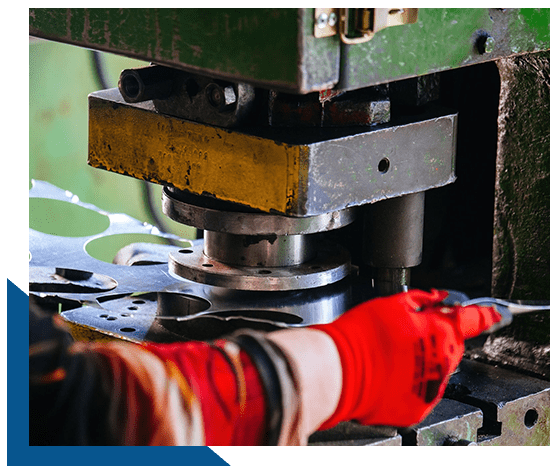
When we bend a piece of 304 stainless steel or 5052-H32 aluminum, the molecules on the outside of the bend stretch, while the molecules on the inside compress. When the press brake ram releases, those molecules try to return to their original home. This is why our operators often “overbend” a part—for example, hitting an 88-degree angle so that it recovers to a perfect 90 degrees. Advanced machinery, such as Accurpress hydraulic brakes, uses real-time sensors to measure this recovery and adjust the stroke automatically.
Bending Methodologies: Finding the Right Fit
Not all bends are created equal. Depending on your project’s tolerances and volume, there are three primary methods to choose from.
Air Bending: The Versatile Workhorse
Air bending is the most common technique in modern shops. The material only touches three points: the punch tip and the two edges of the V-die. The angle is determined by how deep the punch pushes into the die. This method is incredibly flexible; we can use one set of tools to create multiple angles, which keeps your costs down.
Bottoming: For Tight Tolerances
When a project requires higher repeatability, bottoming is often used. Here, the punch presses the material all the way to the bottom of the die. This “sets” the angle more firmly than air bending, significantly reducing springback. It requires more tonnage, but the accuracy is superior for parts that must mate perfectly in an assembly.
Coining: The Gold Standard of Precision
Coining is the “extreme sport” of the fabrication world. The punch and die are brought together with such immense force—often five to ten times that of air bending—that they actually “stamp” the grain of the metal. This virtually eliminates springback and allows for near-zero-radius bends. Coining is usually reserved for high-precision electronics or aerospace components where there is no room for error.
The “Digital Thread”: From SolidWorks to the Shop Floor
The days of an operator “eyeballing” a bend line with a scribe are gone. At SRC, we utilize what we call the “digital thread.” It starts with your CAD files.
By using native sheet metal features in software, we can simulate the bending process before we ever touch a piece of raw material. This allows us to calculate the K-factor—the ratio that determines exactly where the “neutral axis” of the metal lies. This is critical because the metal doesn’t just bend; it grows. Without an accurate bend deduction calculation in the flat pattern, your holes won’t line up once the part is formed.
Our integration software solutions ensure that the data from your drawing flows directly into the CNC controller of our press brakes. This eliminates human transcription errors and ensures that the first part is as accurate as the thousandth.
Overcoming Common Hurdles: Grain and Grade
One of the most frequent challenges we see in metal forming services is the “hidden code” of the metal: grain direction. During the milling process, the grains of the metal are elongated in the direction the sheet was rolled.
If you bend parallel to that grain, the metal is much more likely to crack, much like wood splitting along the grain. Our engineers always look for these “danger zones,” often rotating parts on a laser nest to ensure the bend lines run perpendicular to the grain for maximum structural integrity.
Looking Forward: AI and the Future of Forming
As we move into the future, the landscape of metal forming services is shifting toward intelligent automation. We are seeing the rise of “Smart Machining,” where press brakes use AI to perform predictive maintenance and automated tool path corrections.
Collaborative robots, or “cobots,” are also joining the floor, handling the repetitive, heavy lifting of large panels so our skilled tradespeople can focus on the intricate setups and quality oversight that only a human eye can provide. Sustainability is also a key driver; our shift toward low-VOC powder coatings and high-efficiency fiber lasers helps reduce the environmental footprint of every part we produce.
Why Experience Matters
At the end of the day, you aren’t just buying a bent piece of metal; you’re buying the reliability of your final product. We have seen projects fail because a designer didn’t account for “bend relief”—the small notches needed to prevent tearing at a corner—or because a shop used the wrong V-die opening for a thick gauge of stainless steel.
Trustworthiness in fabrication is built on a foundation of measurable standards. SRC Metal Fabrication maintains a rigorous quality management system, including ISO 9001:2015 certification.
When you partner with a team that has 10, 20, or 50 years of experience, those mistakes don’t happen. We catch them at the DFM (Design for Manufacturability) stage, before you’ve spent a dime on production.
Partner With the Experts at SRC Fabrication
Are you ready to elevate your manufacturing process? Precision, durability, and technical expertise are the hallmarks of SRC Fabrication’s metal forming services. Whether you have a fully finalized design or just a concept that needs professional refinement, our team is here to bring your vision to life with zero-defect quality and competitive turnaround times.
Don’t leave your project to chance. Contact SRC Fabrication today for a comprehensive estimate and see the difference that half a century of expertise can make for your business.

Posted Under: Insights
Request A Quote